Table of Contents
Muley Hacén: the nasrid king whom love destroyed
Muley Hacén (Abu l-Hasan Ali), the penultimate great Nasrid king of Granada, was a fierce and powerful leader. A warrior hardened by a thousand battles, he ruled the last Muslim kingdom on the Iberian Peninsula with an iron fist and an unyielding will. Under his rule, Granada withstood the relentless pressure of the Catholic Monarchs for years, becoming the last bastion of Al-Andalus.
Contemporary chroniclers described him as a man of indomitable character, feared by his enemies and respected by his allies.
But his downfall did not come on the battlefield. It was not the Castilian swords nor the cannons of Isabella and Ferdinand that brought Muley Hacén to his knees. His ruin came from a far more intimate and devastating place: the heart. ❤️🔥
Zoraya, the christian captive who ignited the storm
It all began with a young woman named Isabel de Solís, the daughter of a Christian governor captured during one of the frequent border raids that ravaged the region. She was young, of extraordinary beauty according to the chronicles, and her presence at the Nasrid court did not go unnoticed. Muley Hacén, a mature and powerful man, fell head over heels for her with an intensity bordering on obsession.
Isabel de Solís embraced Islam and took the name Zoraya, which in Arabic means Morning Star. Far from being a mere concubine, the king elevated her to the rank of favorite wife, showering her with privileges and attentions that until then had belonged exclusively to the sultana Aixa, his first and legitimate wife, mother of his children, and a woman of Nasrid lineage.
This love was not merely a private passion. It was a political statement that shook the very foundations of the court of Granada.
The sultana who never forgave
Aixa, also known as Fatima, was not a woman who would accept humiliation in silence. Intelligent, proud, and politically astute, she saw in Zoraya not only a romantic rival, but a direct threat to her children’s future and her own position at court. Jealousy turned to hatred, and hatred to strategy.
She began to weave a conspiracy in the shadows that would change the fate of the kingdom. Her most powerful weapon was neither a dagger nor poison: it was her own son, Muhammad XII, known to history as Boabdil.
Muley Hacén betrayed by his own blood
Aixa convinced Boabdil that he was the legitimate heir to the throne and that his father, blinded by Zoraya, was sidelining him in favor of the children he had fathered with the Christian captive. The seed of ambition, watered by the bitterness of a wounded mother, took root quickly.
What followed was one of the most devastating civil wars the Kingdom of Granada had ever seen: father against son, faction against faction, city against city. Boabdil even went so far as to ally himself with the Catholic Monarchs, his own historical enemies, in order to wrest the throne from his father. The betrayal could not have been more complete or more bitter.
Muley Hacén, old, blind, and sick, was overthrown. The man who had resisted the onslaught of Castile for years finally fell to the conspiracy of his own family. He took refuge in exile, abandoned by almost everyone, with his kingdom fragmented and his honor shattered. His spirit, like the Al-Andalus he had sworn to defend, was broken. 🥀
The last request of the king of Granada
In exile, far from the splendor of the Alhambra, Muley Hacén sensed that death was approaching. Of that powerful man who had ruled Granada, only a shadow remained: blind, without a throne, betrayed by his own kin.
Only Zoraya remained faithful by his side until the end, fulfilling the promise she had made to him when she embraced his Arabic name: never to abandon him.
It was then that the old sultan made his final request:
“Do not bury me in Granada, where men have betrayed me. Take my body to the highest place, where no one can ever tread upon my grave, to sleep eternally near the sky and far from the wickedness of humanity.”
A stormy night and a secret kept for centuries
Legend has it that Zoraya kept her promise to the letter. In the strictest secrecy, amid a storm lashing the mountains, she and a few loyal servants carried the king’s body through the snow and wind, climbing slopes that few dared to cross even in summer.
There was no funeral procession, no ceremonies, no mourners. Only darkness, cold, and the loyalty of a woman who had loved that king when all else had failed her.
Muley Hacén was laid to rest beneath the eternal snows of the most inaccessible peak in the mountains, where heaven and earth meet and where no enemy could desecrate his rest.
Why is the iberian peninsula’s highest peak called Mulhacén?”
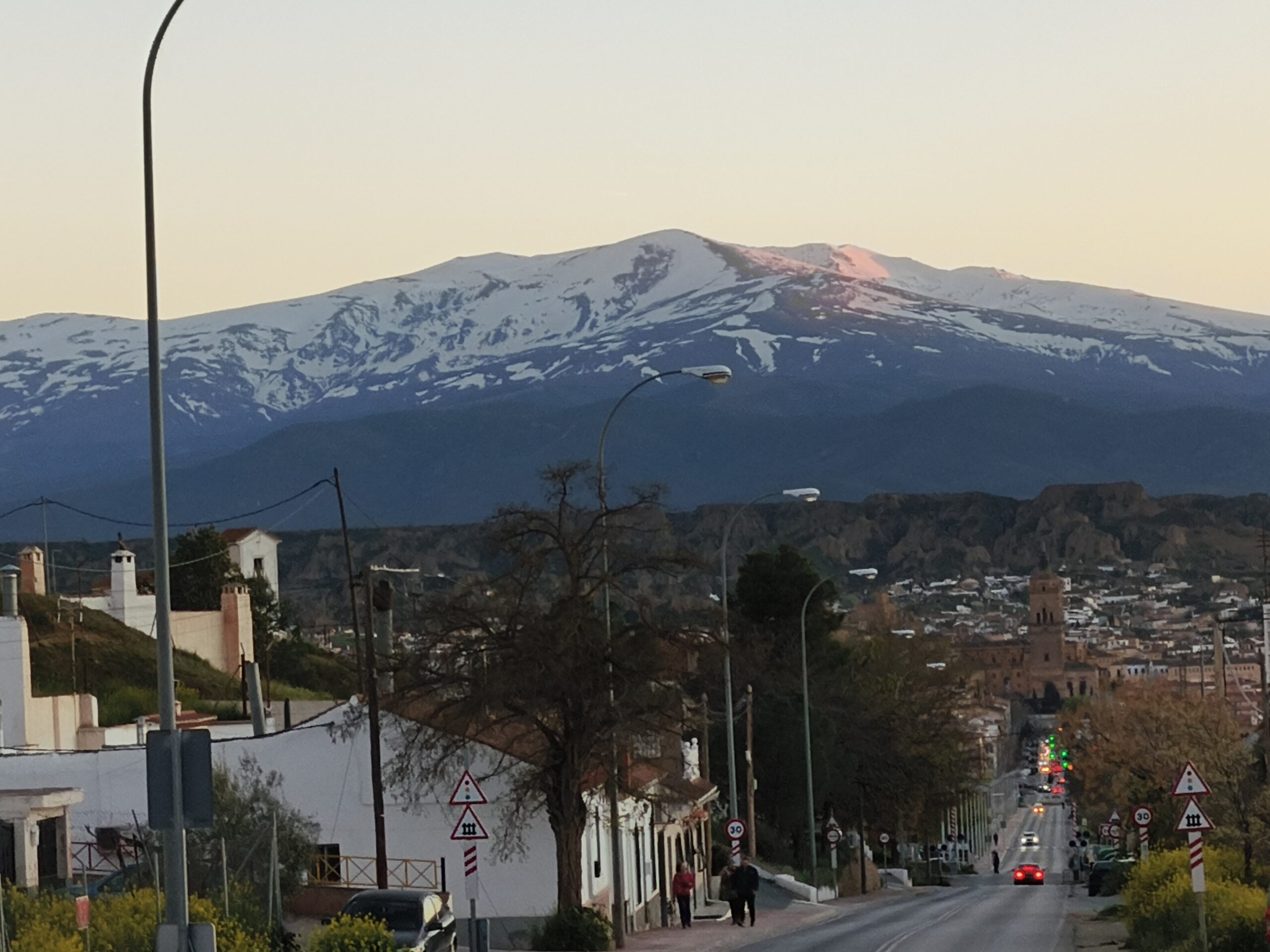
From that day on, that 3,479-meter peak—the highest on the Iberian Peninsula—ceased to be a mere mountain and became something far more powerful: the mausoleum of a dethroned king, the last secret of Al-Andalus.
The Spaniards who arrived later called it Mulhacén, a natural Spanish adaptation of the Arabic name Muley Hacén. The name survived centuries, conquests, and oblivion. Today, millions of people know that peak without realizing that its name bears the story of a forbidden love, a blood-soaked betrayal, and the will of a man who chose the eternal cold of the mountain over the misery of defeat.
Beneath the ice lies the broken heart of a king
The next time you look toward the Sierra Nevada from Granada, or if you are one of the brave souls who have reached the summit of Mulhacén, pause for a moment. Beneath that clear sky, among the ice and rocks, legend has it, lies the broken heart of the last great king of Granada.
A man who had it all: power, glory, and a love capable of setting a kingdom ablaze. And who lost it all, except for the woman who took him to the only place where no one could ever betray him again.
Sources: what is history and what is legend
This article combines documented history with oral tradition. It is important to distinguish between the two: What is documented: The history of Muley Hacén, Zoraya, and the Nasrid civil war is recorded in chronicles from that period.
The most direct source is Hernando de Baeza, an interpreter at the Nasrid court itself, whose work *Relaciones de algunos sucesos de los últimos tiempos del reino de Granada* is considered by historians to be the account closest to the actual events. You can consult it on ResearchGate or in the academic edition from Washington University.
Also essential is the study by López de Coca Castañer, *La conquista de Granada: el testimonio de los vencidos* (The Conquest of Granada: The Testimony of the Vanquished), available at DEHESA, University of Extremadura. The capture of Isabel de Solís in 1481, her conversion to Islam under the name Zoraya, and her role as Muley Hacén’s favorite wife are documented in various chronicles. Her full story can be read on Mujeres en la Historia and in El Español.
What is legend:
The story of the burial on the summit—Muley Hacén’s request, the storm, Zoraya carrying the body up to the snow—does not appear in any primary source. It is an oral tradition that became popular in the 19th century during the Romantic era, quite possibly influenced by Washington Irving’s *Tales of the Alhambra* (1832).
What is accepted by most historians is that the name Mulhacén derives from Muley Hacén, and that the king died in 1485 in Mondújar, in the Lecrín Valley. The legend, though unverifiable, forms part of the cultural heritage and identity of Granada and the Sierra Nevada.
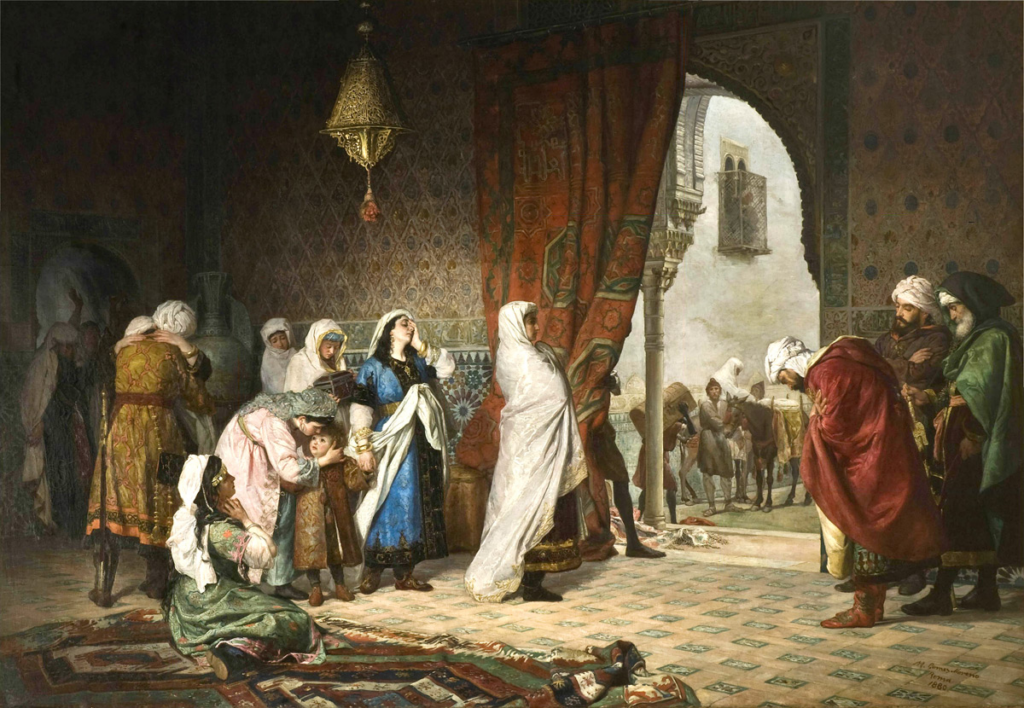
The image illustrating this story, “The Departure of Boabdil’s Family from the Alhambra,” is a masterpiece by the Granada-born painter Manuel Gómez-Moreno González (1880). This piece captures the drama of exile and the end of an era, faithfully reflecting the melancholy of the legend we are discussing today. The work is in the public domain and was obtained through the Wikimedia Commons / Wikipedia.
🚶 Free tours and guided tours
Granada captivates with its historical legacy, cultural richness, and diverse landscapes. But beyond the capital city, the province holds unique places that are well worth a visit. One of them is Guadix, one of Andalusia’s most unique cities and the gateway to the Granada Geopark.
Discover Guadix with our free tours and guided visits. Stroll alongside local guides through its historic center, admire the imposing Cathedral, discover its palaces, explore the iconic cave house neighborhood, and let yourself be amazed by the history, traditions, and charm of a city that preserves centuries of heritage in every corner.


Leave a Reply