
- This event has passed.
City of water 2026. City Council guided tour
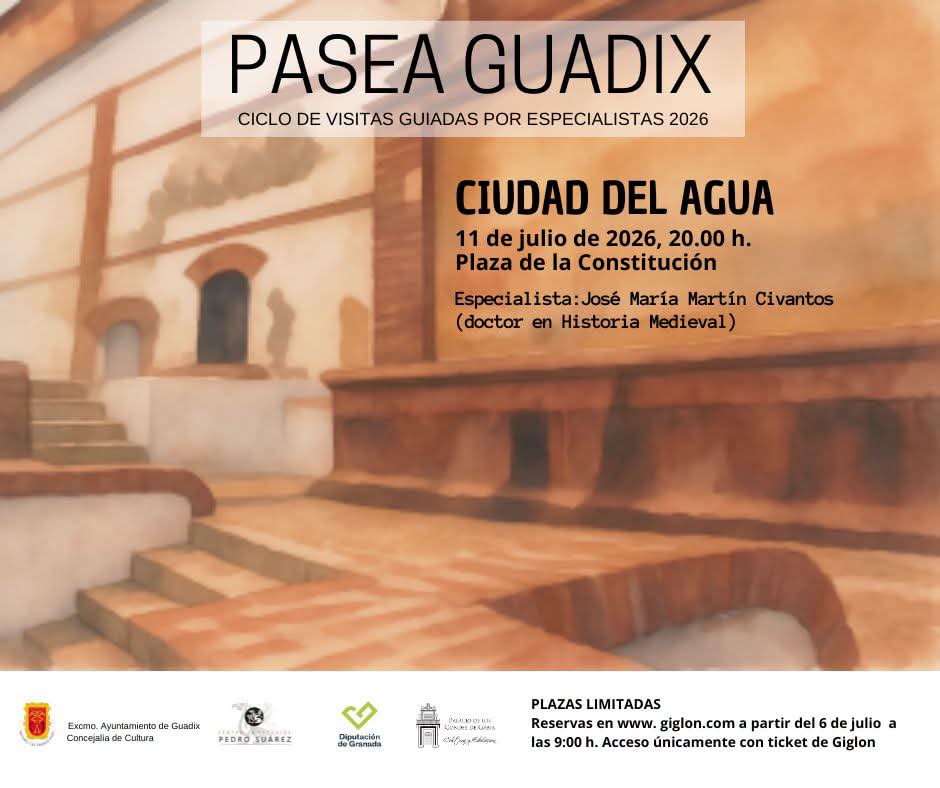
Reservations open on July 6 at 9:00 AM through the Giglon platform. Access to the activity will only be permitted with a reservation ticket. Don’t wait until the last minute!
Book here
Pasea Guadix 2026: discover your city like never before
Pasea Guadix is the cycle of guided tours organized by the Department of Culture of the Guadix City Council, represented by Encarni Pérez, with the collaboration of the Provincial Council of Granada through the Delegation of Culture and Education, and the scientific advice of the Pedro Suárez Center for Studies. A program that every year leads residents and visitors to discover corners, histories, and layers of Guadix that go unnoticed in everyday life.
The key to Pasea Guadix lies in its guides: these are not typical sightseeing tours, but routes led by specialists—historians, archaeologists, geographers, researchers—who share their deep knowledge of Guadix’s heritage with the public. Each visit is, in fact, an open-air masterclass, accessible to everyone and designed to awaken curiosity about the place we live in.
With each new edition, the program confirms that Guadix has much more to tell than we imagine. This time, the connecting thread is water.
City of Water: irrigation channels, fountains, and waterways that made Guadix possible
Did you know that Guadix has a relationship with water that dates back over a thousand years? The city we know today would not be possible without the sophisticated hydraulic system that its inhabitants—Romans, Arabs, Christians—built and perfected over the centuries. Irrigation channels, pillars, fountains, waterways: an invisible network that runs through the city and that, even today, forms part of its urban and historical landscape.
The tour “City of Water” proposes to discover exactly that: the layout, history, and meaning of those hydraulic infrastructures that have shaped Guadix for generations. Throughout the tour, participants will be able to see and understand how this water management system functioned—and in many cases, how it continues to function—which was fundamental for the urban, social, and economic development of the city.
“Water is not just a resource: it is the thread that connects the history of Guadix from its origins to the present day. A collective heritage that deserves to be known and cared for.”
The route will address the origins of the hydraulic infrastructures of Guadix, tracing their roots back to medieval times and analyzing how they evolved over time. We will tour irrigation channels and waterways that are still visible in the urban landscape, and explain the role that pillars and public fountains played in the daily lives of the people of Guadix throughout the centuries.
Beyond the technical aspect, the visit will also invite reflection on water management as an essential resource and collective heritage: an asset that has determined who lived where, how society was organized, what economic activities were possible, and how the city’s public space was configured. In that sense, to understand the water of Guadix is to understand Guadix itself.
Departure will take place at 8:00 PM from the Plaza de la Constitución. The evening schedule is also a great choice: touring the city at sunset on a Saturday in July, when the light changes and the heat of the day begins to subside, turns the walk into a doubly pleasant experience.
)
José María Martín Civantos: the medievalist who knows the water of Guadix like no one else
The tour will be guided by José María Martín Civantos, PhD in Medieval History and one of the most renowned researchers in the study of Andalusi hydraulic heritage and landscape archaeology in the southeastern peninsula. His academic work has specifically addressed the relationship between medieval societies and water: how they organized themselves to capture, distribute, and manage it, and what traces those infrastructures left on the territory.
Martín Civantos knows the ground we walk on. His research has included the study of the irrigation systems around Guadix and the Marquesado del Zenete, making him the ideal person to guide this tour. It’s not just someone who knows a lot about the subject in the abstract: it’s someone who has specifically studied this territory, these irrigation channels, this city.
In addition to his scientific rigor, Dr. Martín Civantos has a renowned ability to disseminate information: he knows how to explain complex concepts in an accessible way, connect the past with the present, and make history come alive before the eyes of those who listen to him. A combination that makes this walk a unique opportunity to learn and enjoy at the same time.
Three reasons to reserve your spot now
Water as the key to the history of Guadix
Guadix is a city that cannot be understood without water. Its very name—derived from the Arabic Wadi Ash, “river of life”—says it all. Located in a semi-arid territory between the Sierra Nevada and the Guadix-Baza desert, the city exists and prospered precisely because its inhabitants learned to manage water in an extraordinarily intelligent and efficient way.
The first documented hydraulic infrastructures in Guadix date back to Roman times, but it was during the Andalusi period that the system reached its maximum development and sophistication. The medieval communities that inhabited this land built a network of irrigation channels and waterways that harnessed the waters of the sierra to supply farmland, mills, public baths, pillars, and homes. A system that, in many aspects, we can still trace in the urban landscape today.
After the Castilian conquest of the 15th century, those infrastructures did not disappear: they were adapted, expanded, and continued by the new populations. Water remained the backbone of urban life, determining the location of economic activities, the distribution of public space, and the social organization of the city. To understand that system is to understand the history of Guadix in all its complexity.
Today, in a context of climate change and growing water scarcity, that history also has a contemporary dimension: the water management systems developed by our medieval ancestors contain lessons in sustainability and efficiency that remain relevant. In that sense, visiting the hydraulic heritage of Guadix is also a reflection on our present and our future.
Everything you need to know to participate
Spots for this activity are limited, and participation requires prior reservation through the Giglon platform. Reservations will open on July 6, 2026, at 9:00 AM, so we recommend you keep an eye out for that date and time if you don’t want to miss out.
Access to the activity will be strictly by means of the corresponding reservation ticket. Entry will not be allowed without a prior reservation, regardless of spot availability at the time of departure. That is why it’s important that you process your reservation from the very beginning.
Departure will take place promptly at 8:00 PM from the Plaza de la Constitución. We recommend arriving a few minutes early. The activity is suitable for all ages, although comfortable walking shoes are recommended. Given the time of year, it is also advisable to bring water and light clothing.
For any questions about the Pasea Guadix program or this activity in particular, you can contact the Department of Culture of the Guadix City Council. And if you found this proposal interesting, share it with family, friends, and neighbors: the more people participate, the more alive culture will be in our city.
Reserve your spot starting July 6
Spots are limited. Don’t wait until the last minute.
🕖 8:00 PM
📍 Plaza de la Constitución
🎟 1.81€ with reservation on Giglon

