
- This event has passed.
EXHIBITION The Forgotten Science: A Tribute to Doctor Antonio Chamorro Daza
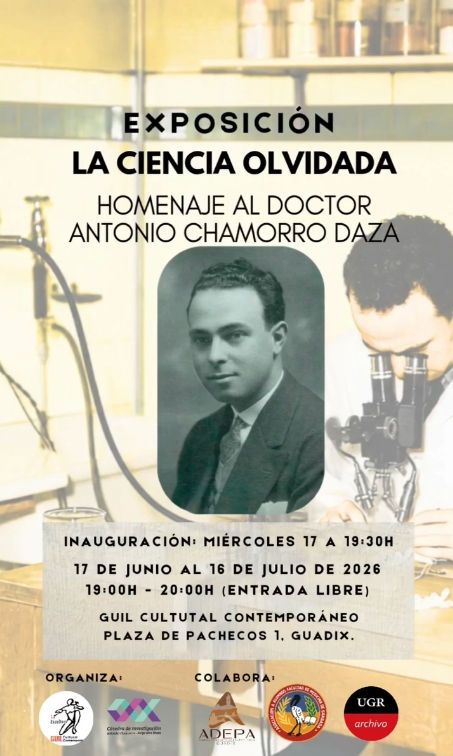
Guadix has a scientific history that deserves to be known and shared. From June 17 to July 16, 2026, Guil Cultural Contemporáneo will host the exhibition “The Forgotten Science. A Tribute to Doctor Antonio Chamorro Daza”, a journey through the life and work of one of the most prominent figures in Accitan research and 20th-century Spanish science. Admission is free, and visiting hours are from 19:00 to 21:00 hours. At Quo Wadis Tours, your company for guided tours in Guadix, we encourage you to discover this extraordinary chapter in our city’s history.
Who was Doctor Antonio Chamorro Daza?
Guadix has given Spanish history figures who have shaped culture, arts, and thought: the Golden Age playwright Antonio Mira de Amescua, the Andalusi philosopher Ibn Tufail, the Baroque sculptor Torcuato Ruiz del Peral, and the novelist Pedro Antonio de Alarcón. Yet, there are names that, despite having made decisive contributions to the progress of knowledge, remain in the shadows. Antonio Chamorro Daza is one of them.
A doctor and researcher born in Huesa (Jaén), Chamorro Daza developed his scientific work in 20th-century Spain amidst immense difficulties: the Civil War, the post-war period, and the limitations of Spanish science at the time. Despite these hurdles, his contribution to medicine and research was significant. His figure represents more than just an individual career; it embodies the history of all those Spanish scientists who worked in the shadows without the recognition they deserved, and whose legacy time has, in too many cases, buried.
This exhibition was born precisely from the desire to rescue that legacy from oblivion—to restore Doctor Chamorro Daza to his rightful place in the memory of Guadix and, by extension, in the history of Spanish science. Because recovering scientific memory is also a matter of justice and collective pride.
“Recovering the scientific memory of Guadix is also a form of justice and collective pride. Doctor Chamorro Daza deserves this recognition.”
What you will find in the exhibition
Through documents, photographs, objects, and archival materials, the exhibition explores the life and work of Doctor Chamorro Daza. It is an itinerary that is simultaneously biographical, scientific, and historical: it does not merely speak about a man, but about the context in which he lived, the state of Spanish science during his era, and the role that Guadix played—and still plays—in the production of knowledge.
📷
Images documenting the life and professional path of Doctor Chamorro Daza, from his training years to his active research career.
📄
Manuscripts, publications, correspondence, and archival materials that reveal the depth and rigor of Chamorro Daza’s research work, organized in collaboration with the University of Granada Archives.
🔬
A look into the state of 20th-century Spanish science: its highlights, its shadows, and the conditions under which researchers like Chamorro Daza had to carry out their work.
🏠
The exhibition places Guadix on the map of Spanish scientific research, vindicating the city’s contribution to the progress of knowledge far beyond its borders.
Programme of activities
Throughout the weeks of the exhibition, various activities and public events will take place, completing and enriching the display with the presence of specialists, creators, and academic authorities:
📌 Registration for Workshops and Guided Tour
Places for the activities on June 26th, June 29th, and July 3rd are limited. Advance registration is compulsory by sending an email to: guilculturalcontemporaneo@gmail.com
The Forgotten Science: A title that is also a call out
The title of the exhibition is not accidental. “The Forgotten Science” is a statement and, at the same time, a question: why do we forget those who dedicated their lives to knowledge? What social, political, and institutional mechanisms cause some figures to be celebrated while others fall into anonymity? What do we lose when we let scientific memory fade away?
In the case of 20th-century Spanish science, this oblivion was not random. The Civil War and the Franco dictatorship caused a traumatic rupture in the Spanish scientific tradition: the exile of researchers, the destruction of projects, the censorship of publications, and the disappearance of institutions. Many scientists who had worked with rigor and dedication saw their legacy erased. Doctor Chamorro Daza is one of those cases—an Accitan researcher whose work deserves to be recovered, studied, and valued.
This exhibition is, therefore, much more than a personal tribute. It is an act of collective memory. A way to show that Guadix does not only possess artistic and monumental history: it also has a scientific history, and that history belongs to all of us.
“This exhibition is not just a personal tribute. It is an act of collective memory that highlights Guadix’s contribution to the history of Spanish science.”
Guil Cultural Contemporáneo: A space of memory and living culture in Guadix
The Guil Cultural Contemporáneo, located at Plaza de Pachecos 1 in Guadix, has established itself in recent years as one of the city’s most active and committed cultural spaces. It is a venue that curates with intent, choosing its proposals based on the types of conversations it wants to spark within the community, understanding culture as an instrument for social transformation and the recovery of collective memory.
It makes perfect sense for Guil Cultural Contemporáneo to host this exhibition: it perfectly defines their editorial line. Art, science, history, and memory combine in a showcase that does not simply seek to inform, but to move and activate the historical awareness of its visitors.
The exhibition features collaborations with top-tier institutions: the Guadix Research Center, the ADEPA association, the University of Granada through its Archives, and the Granada Faculty of Medicine. This institutional backing ensures the seriousness and rigor of an initiative that aims to leave a lasting mark on the city’s memory.
Guadix and its scientific legacy: More than we imagine
Guadix is known throughout Spain and the world for its spectacular monumental heritage and its unique landscape of cave houses. But there is another Guadix, lesser-known yet equally important: the Guadix of knowledge and research. A city that has produced brilliant minds in fields as diverse as philosophy, theology, the arts, and, as this exhibition reminds us, science.
The Andalusi scholar Ibn Tufail, born in Guadix in the 12th century, was one of the most influential philosophers of the medieval Arab world: his philosophical novel The Self-Taught Philosopher was read and debated across Europe for centuries. Many centuries later, Doctor Chamorro Daza continued that tradition of intellectual rigor and love for knowledge, this time from the laboratories and clinics of modern medicine.
Recovering this legacy is not just an act of justice for those who can no longer speak for themselves. It is also a way of building the collective identity of a city—telling the youth of Guadix that great things have been achieved right here, in this territory. That curiosity, rigor, and scientific calling have deep roots in this land, and they can proudly feel like the heirs to that tradition.
Five reasons to visit The Forgotten Science
Because you will discover a part of Guadix’s history that you probably did not know: its 20th-century scientific legacy.
Because the activities program includes the presence of the Dean of Medicine of the UGR and the Rector of the University of Granada: a clear sign of the academic importance of this initiative.
Because the guided tour with Ignacio Melgares on June 29 offers an in-depth perspective that you cannot get on a self-guided visit: book your spot.
Because admission is free and the Guil Cultural Contemporáneo venue is one of the finest and most welcoming spaces in the city.
Because the closing ceremony on July 16 with the Rector of the UGR and a musical tribute will be a historic moment for Guadix that shouldn’t be missed.
Discover the complete history of Guadix with Quo Wadis Tours
If The Forgotten Science exhibition has sparked your interest in the history of Guadix beyond its monumental heritage, we at Quo Wadis Tours can help you explore it thoroughly. We are a guided tours company in Guadix specializing in showcasing all the layers of this unique city: its Roman history, its Andalusi splendor, its Renaissance and Baroque architecture, its cave houses, and the extraordinary figures it has given to culture and knowledge.
The city that brought forth the philosopher Ibn Tufail, the playwright Mira de Amescua, the novelist Pedro Antonio de Alarcón, and the scientist Antonio Chamorro Daza is a city that deserves to be explored with those who truly know it. Private groups, families, educational centers, and solo travelers are all welcome. Contact us and we will design the tour that best suits your interests.
Quo Wadis Tours · Guided Tours in Guadix
Visit the exhibition and then explore the city with us. History, heritage, geology, cave houses, and the characters that made Guadix great. Private groups, families, and school trips.
🔬 Exhibition · Guadix · Science and History
The Forgotten Science
A Tribute to Doctor Antonio Chamorro Daza
June 17 – July 16, 2026 · 19:00–21:00h · Free Admission
Guil Cultural Contemporáneo · Plaza de Pachecos 1, Guadix

